



How to Keep Your Dog Visible on Dark Walks By Reelight | Reading time: 5 minutes
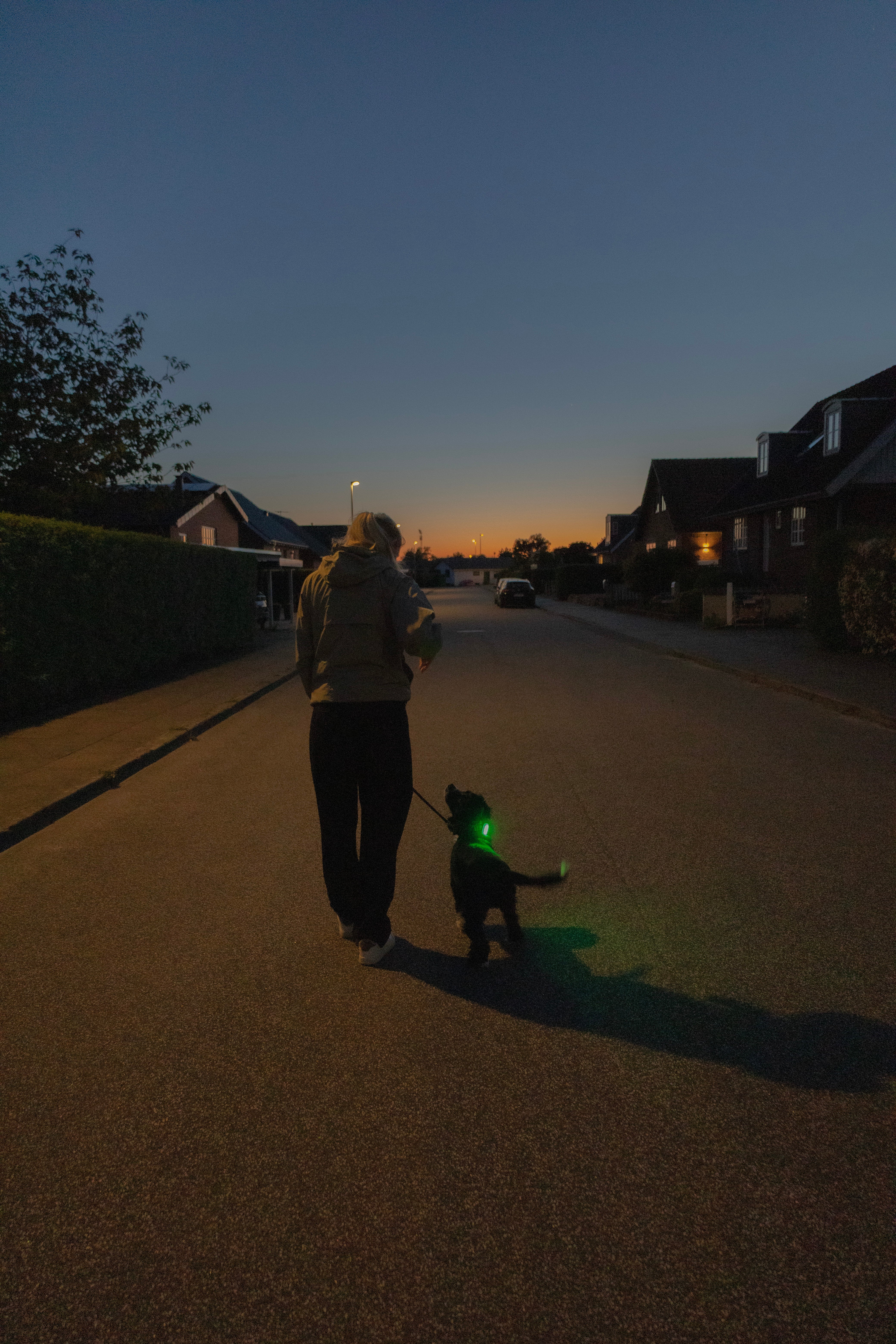
It's nine in the evening and you're out with the dog. To you the road looks perfectly clear. You can see the pavement, the parked cars, the shape of your dog trotting a few steps ahead. It doesn't feel dark.
To a driver coming the other way, your dog is a low, dark shape moving below the headlight beam, with almost nothing to separate them from the road surface behind. By the time that driver picks your dog out of the background, the distance left to react may be a good deal shorter than the distance needed to stop. That gap is what this post is about, and it's smaller and more common than most of us think.

The riskiest hours are not the ones you'd guess
It's tempting to think of this as a deep-winter, middle-of-the-night problem. It isn't. It's the ordinary walks: the one before work in October, the one after dinner in February, the grey stretch of a Sunday afternoon in November when the light goes without warning.
Two recent European studies land on the same conclusion. A 2026 study published in the Journal of Transport Geography analysed 4,443 dog and cat vehicle collisions and found them peaking in the late afternoon, between six and seven in the evening, with a second peak around midnight. The researchers tie that pattern directly to how much harder it is for drivers to see once the sun has gone down.
A separate 2026 study from Lithuania, published in Safety, found the same pattern in a Northern European climate: clear peaks around sunrise and sunset, concentrated in built-up areas where dogs and traffic share the same space.
Two countries, two climates but one answer. The dangerous window is the transition between light and dark, not the complete night. Which is unfortunate, because that's exactly when most of us tend to go for a walk.
One honest caveat about the research: both studies look mainly at free-roaming and stray animals rather than leashed dogs on an evening stroll. The exposure is different. But the mechanism, a low, low-contrast body moving through fading light, is identical whether your dog is on a leash or not. The bad visibility is not improved by using a leash.

Why your dog disappears before you notice
Two things are working against you when walking your dog during darker hours, and neither of them might be obvious.
The first is the coat colour of your dog. A black Labrador, a Rottweiler, a dark Shepherd, all of them melt straight into wet tarmac. Lighter dogs do better, but not nearly as well as their owners assume. If you've ever lost sight of your own cream-coloured dog in a dim field for a few seconds, you already know how quickly it happens.
The second is height. Dogs move at roughly knee level, which is below the main throw of a car's headlights. They occupy the part of the scene a driver's eyes are least drawn to, against a background of road, grass, or gravel that's much the same tone as they are. Without something actively emitting light, your dog often simply isn't registered by drivers or other pedestrians.

Reflective collars help, but they're not a solution
A reflective collar is passive. It has no light of its own, so it only does anything when a light source hits it from roughly the right angle and bounces back.
That means it works reasonably well when a car is coming head-on with headlights aimed at your dog. It does very little when the car is turning, when the road curves, or when your dog is off to the side of the beam. And on the shared paths where a lot of us actually walk, cyclists often have nothing pointed at your dog at all. From behind, reflective gear gives you almost nothing. It's a sensible first step. It just isn't the whole answer.
What actually works, and the number that misleads people
An active LED light solves the problem reflective gear can't, because it makes its own light and doesn't wait to be found. But dog lights vary enormously in quality, and the specification that matters most is usually the one cheap brands leave off the box.
Most lights are sold on lumens. Forty sounds better than twenty, so forty must be safer. The catch is that lumens only describe how much light a source makes, not where any of it goes. A high-lumen light with a narrow beam pours nearly everything into one direction. Stand at the side of that light and you'll barely notice it. Your dog gets a bright spot pointing at nothing in particular and remains effectively invisible from every other angle.
Beam angle is what actually decides whether your dog gets seen, because in traffic the threat arrives from all sides. A wide-angle light spreads its output across a broad arc, so your dog stays visible from the front, the side, and behind at the same time. It keeps working when they turn their head or wander to the end of the leash. And a wide, even spread has a much better chance of getting through thick or long fur, where a concentrated beam tends to get swallowed at a single point. If you have a husky or a long-coated retriever, you have probably already watched a light look impressively bright in your hand and then vanish entirely once it's buried in the coat.
As a rough guide: under 10 lumens is close to decorative, whatever the beam. Fifteen or more with genuine wide-angle distribution is where real-world visibility starts. And a big lumen number with a narrow beam is a specification designed to look good in a listing rather than on a dark road.

Where the SWITCH comes in
We built the SWITCH around that principle rather than the lumen race.
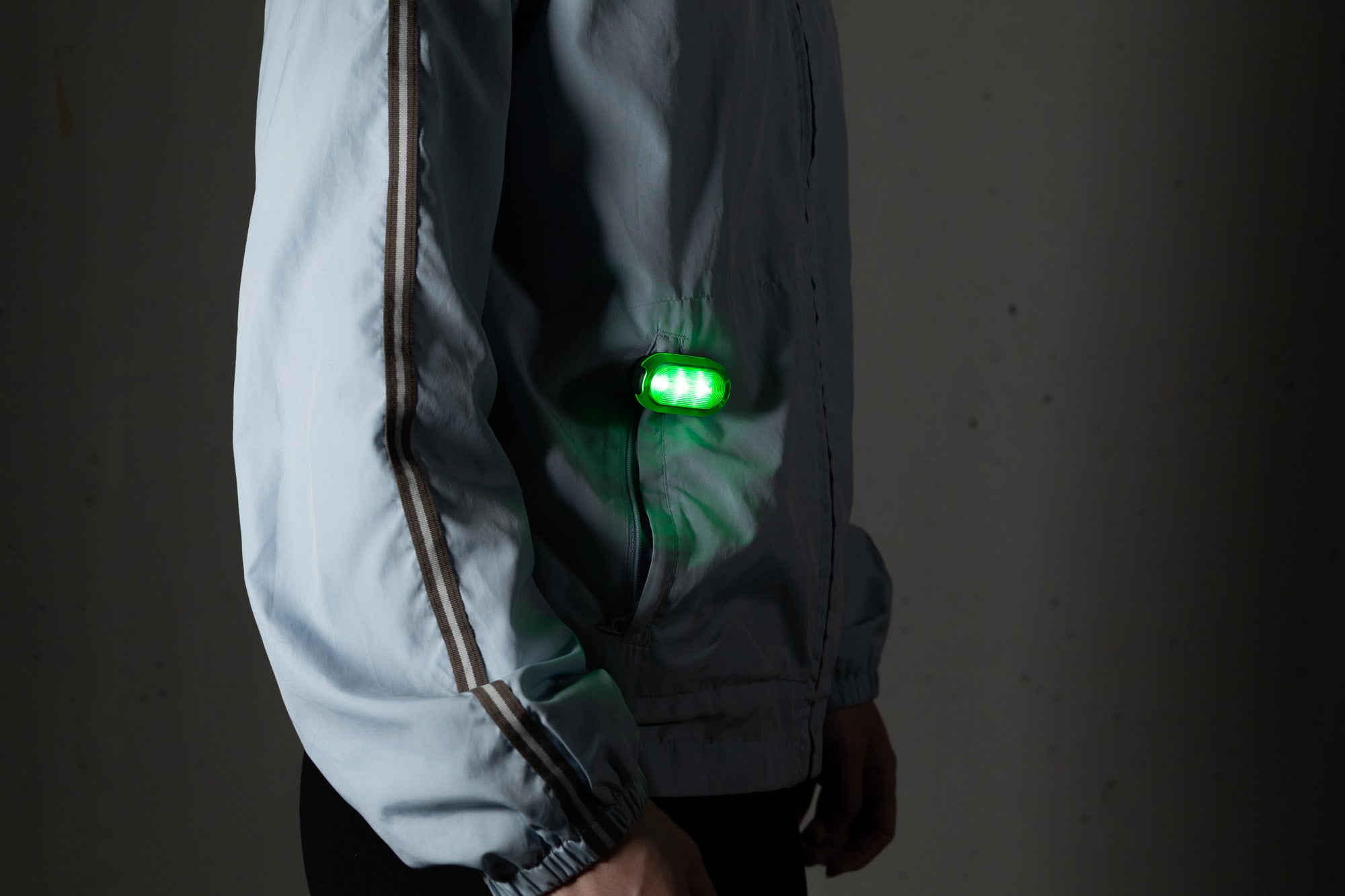
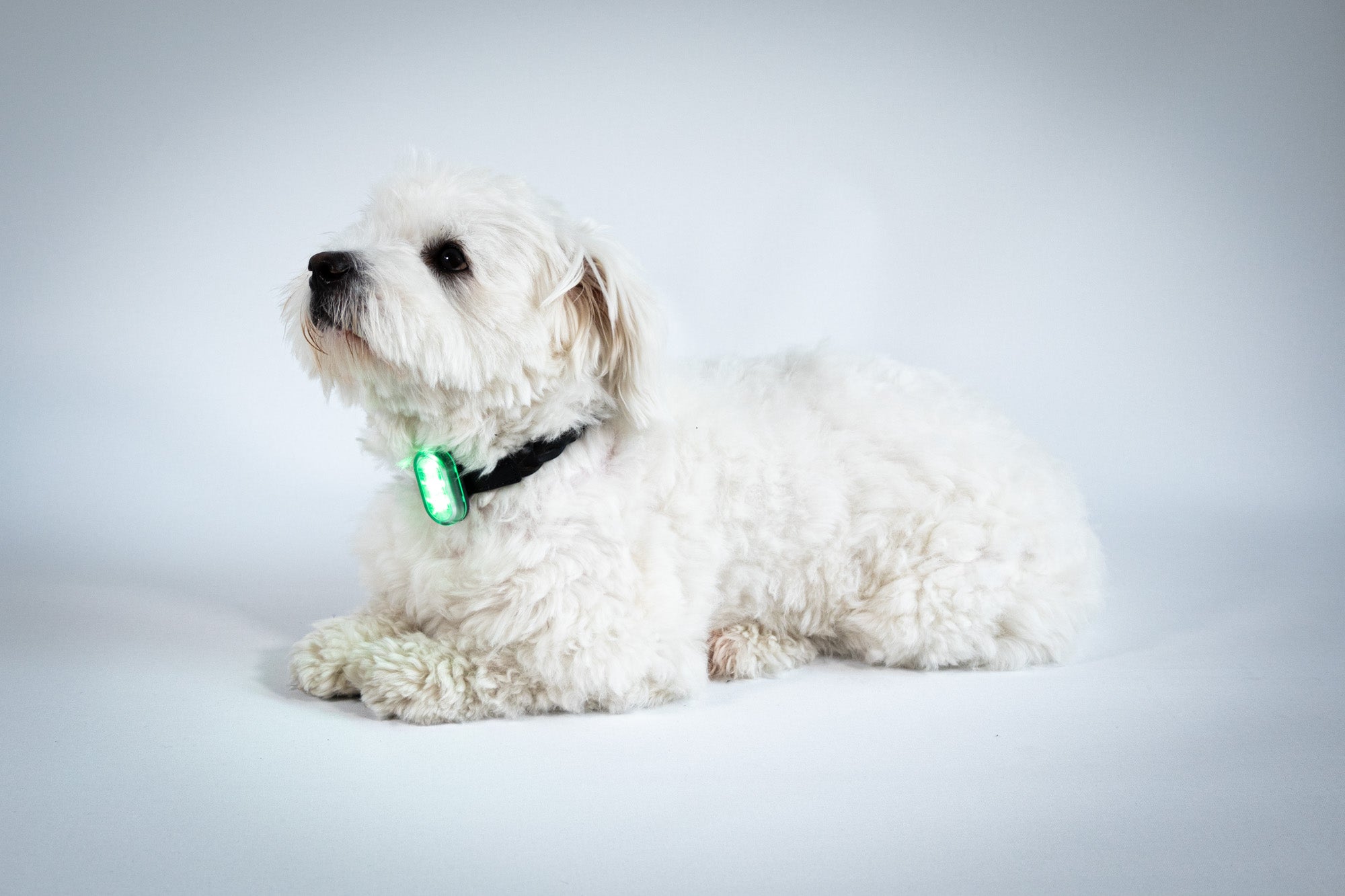
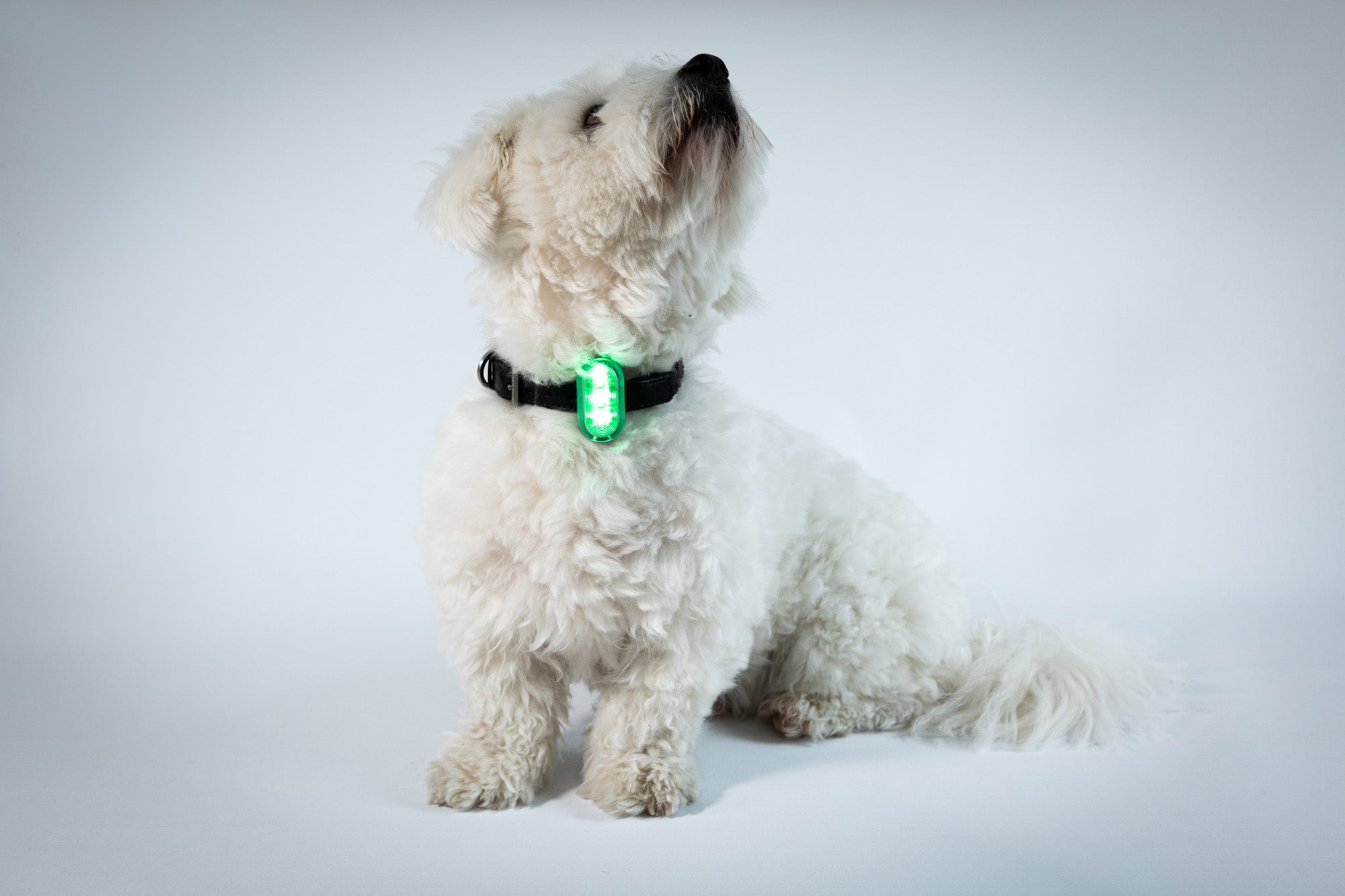
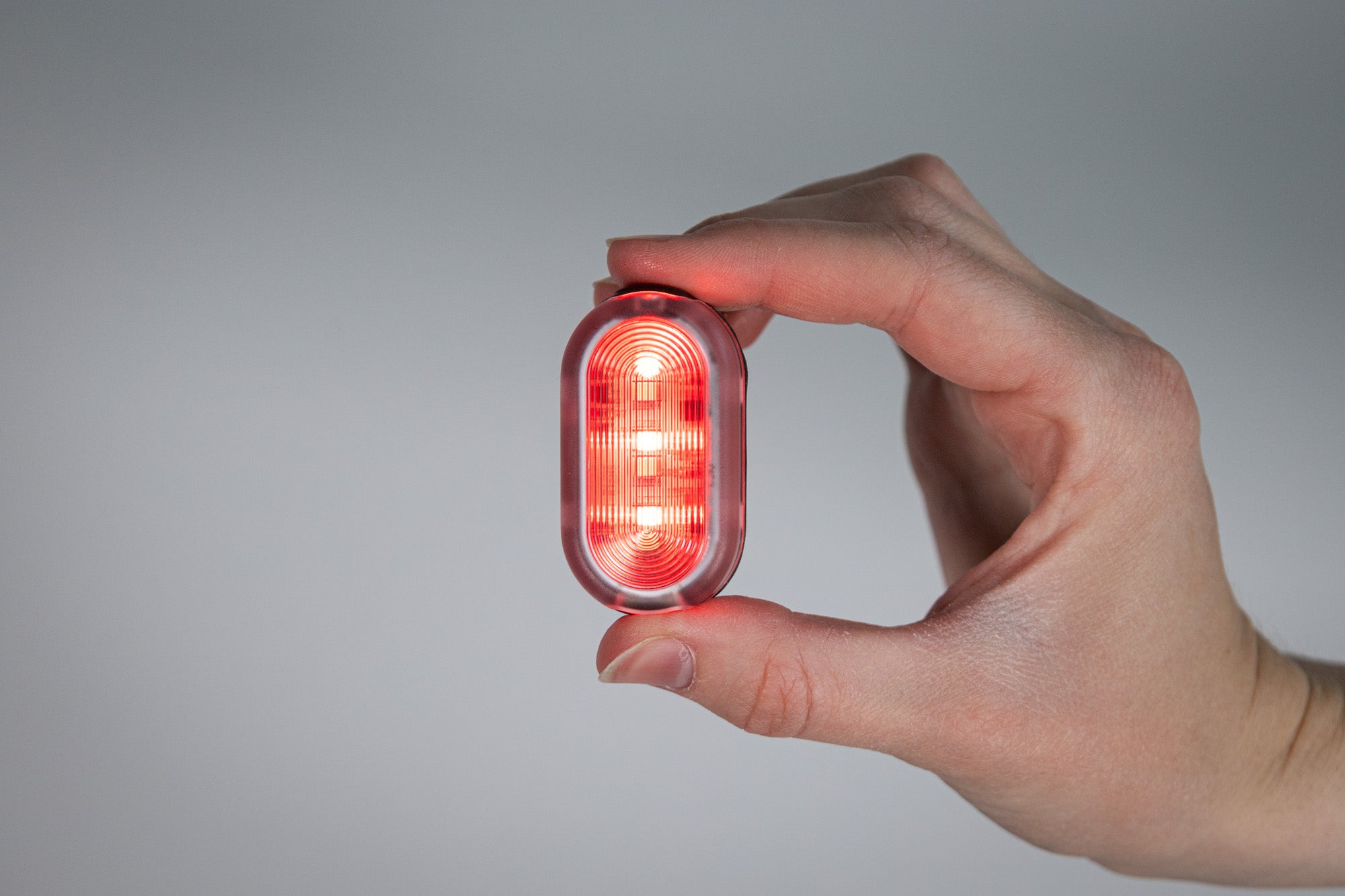
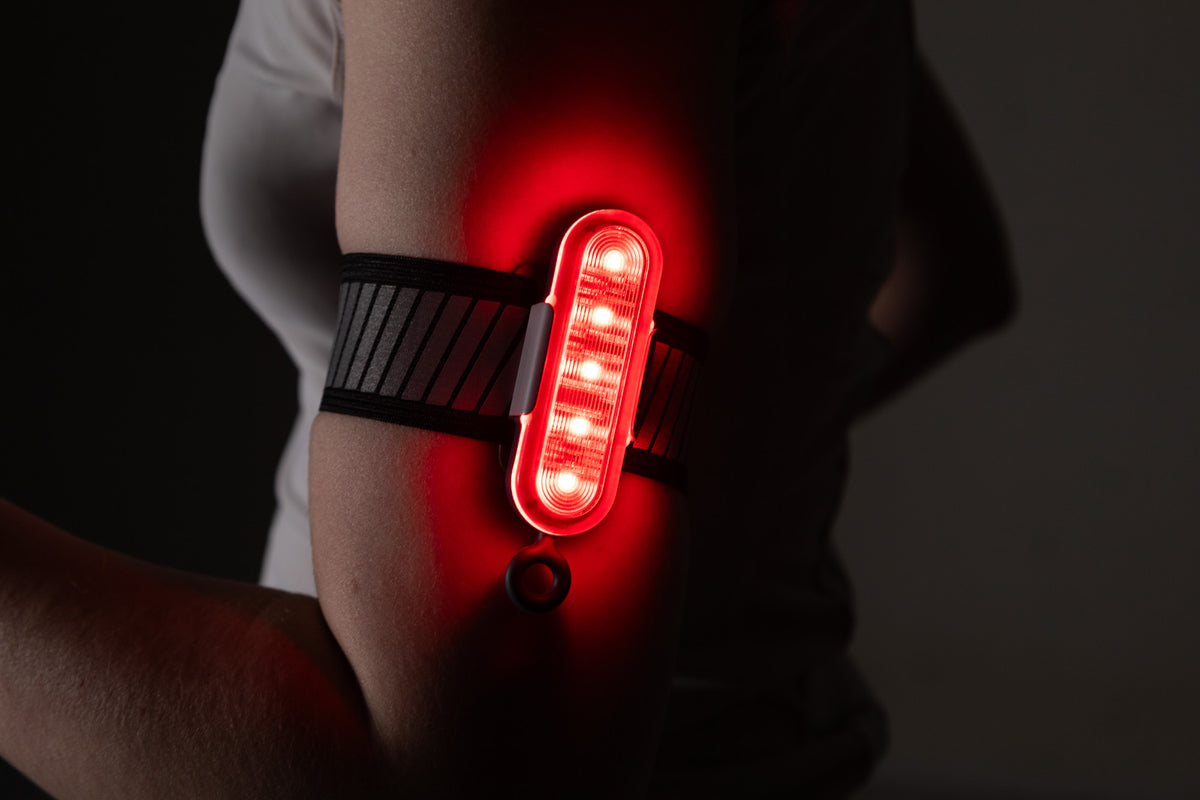
It uses wide-angle 3-LED optics to spread 22 lumens across a broad arc, so your dog is seen from every direction instead of lit from one. It's bright enough to register clearly with drivers and cyclists without being harsh at close range, and the wide spread is designed specifically to stay visible through thick and long coats. IPX4 water resistance covers rain, fog, and morning dew, as well as dogs who enjoy spending time around ponds or the sea. It clips onto any collar or harness in seconds, comes in three colour options (white paired with red, green, or orange), and there's an optional Lock Ring for larger dogs and the ones who are hard on their gear.
The part we're most pleased with is the battery system, because a light that dies quietly halfway through a walk is arguably worse than no light at all. The SWITCH warns you with an orange flash at 20%, then drops automatically into Reserve Mode at 10%, which extends runtime by up to two hours. You get home visible. A full charge over USB-C takes an hour.

Before tonight's walk
You don't need to overhaul anything. A few small things stack up:
- Clip on an active LED light. This one step makes the biggest single difference.
- Wear something light-coloured yourself. A driver who spots you starts looking for what's attached to you.
- Use a fixed-length leash when the light is poor. Retractables put your dog somewhere unpredictable, often several metres out into the road.
- Walk facing oncoming traffic where you can. You see what's coming, and drivers get longer to see you.
- Give your usual route a second look. A path that's perfectly fine in July can have long black stretches in November.
The point isn't which light you buy
We make lights, so we're hardly neutral. But the honest takeaway here isn't that you need our light specifically. It's that dog visibility in the darker months is one of those risks that's easy to underestimate precisely because nothing has gone wrong yet. Most walks are uneventful. The road looks fine. Your dog comes home.
The research points at a narrow, predictable window of risk, the hours when the light is going, which happen to be the hours most of us are out. That's worth taking seriously whatever you clip to the collar.
So pick a light with a genuinely wide beam, enough brightness to matter, and a battery that tells you when it's running low. Check that it still works on your dog's coat rather than just in your hand. Everything above is what we've learned building these lights and walking our own dogs in a Northern European autumn, backed up by what the collision data actually shows.
The distance between visible and invisible is genuinely small. Closing it takes about ten seconds before you reach for the leash.

Reelight makes compact, rechargeable safety lights for cyclists, runners, and dogs. The SWITCH dog safety light comes in three colour options and ships across Europe.
Sources
Linck et al. (2026). Paws on the road: Spatiotemporal risk analyses of dog and cat vehicle collisions. Journal of Transport Geography. DOI: 10.1016/j.jtrangeo.2026.104684
Land Cover and Temporal Effects on Dog-Vehicle Collisions in Lithuania (2026). Safety, MDPI. DOI: 10.3390/safety12020051
Internal links: SWITCH product page, About Reelight