



How Less Movement in Winter Affects Your Dog’s Body, and How to Help.
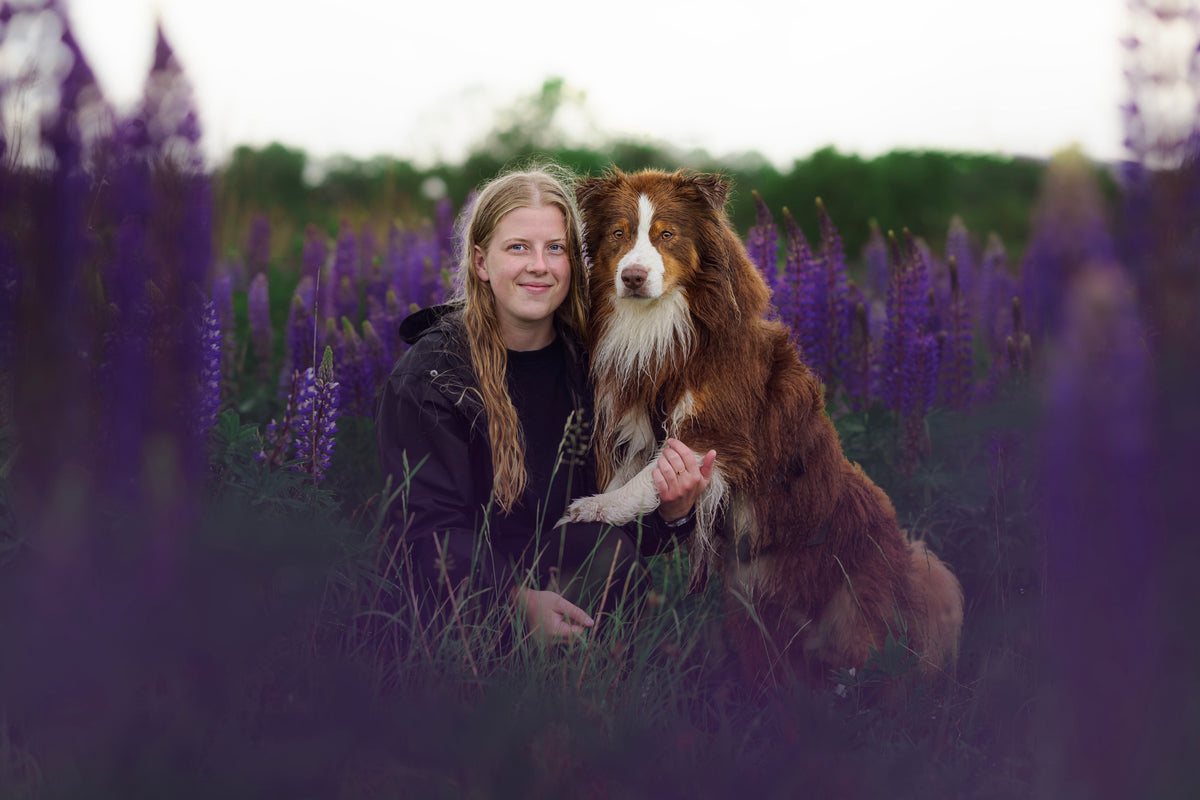
Sofie is a certified dog trainer and instructor, canine massage therapist and canine craniosacral therapist based in Denmark, and she is currently studying to become a canine osteopath. She shares her everyday life with her Australian Shepherd, Dexter.
When she isn’t out with Dexter, Sofie is usually working with other dogs. She offers therapy sessions such as massage and craniosacral therapy to help dogs with physical imbalances, and she teaches dog owners at her local Danish Civilian Dog Handlers club.
In this post, Sofie explains how shorter, darker winter days can affect how much your dog moves, and what that means for its muscles, joints, weight and overall well-being. She shares which changes in movement to look out for, and simple ways to keep your dog active and healthy through winter, from scent work and short training sessions to gentle indoor exercises.

When temperatures drop and the days become shorter, it can affect how much your dog moves throughout the day. Walks may become shorter, and some of the activities that you usually do together may become less frequent.
This is not necessarily a problem in itself, but if your dogs activity levels decrease significantly over a longer period of time, it can affect both its body and overall well-being.
To understand this, it is relevant to look at how movement affects your dogs muscles and joints. The muscles help create movement, but they also have an important function when it comes to stabilizing the joints and supporting the body, during activity.
When your dog moves regularly, the muscles are being used and maintained through the physical demands placed on them. However, if the activity level decreases over a longer period of time, both muscle strength and muscle mass may gradually decrease. How much this affects your dog depends on several factors, including its age, physical condition and general activity level.

It is also relevant to look at how the joints function and how the body maintains its mobility. When your dog walks, runs, turns and moves across different surfaces, the muscles, joints, tendons and ligaments all work together. At the same time, these movements challenge your dog's balance and coordination. If your dog moves less and has fewer opportunities to use its body in different ways, it may lose some of its physical fitness and become less used to certain movements. This can become especially noticeable if, and when, your dog suddenly returns to a higher activity level after a period with less exercise.
It is therefore important to pay attention to your dog's overall movement patterns. Perhaps your dog seems stiffer when getting up after resting, takes shorter steps or is less willing to jump into the car.
These changes can have different causes, and it is therefore important not to automatically assume that they are related to a lack of exercise or colder temperatures. They may also be signs of pain or other issues that need further examination.
Less movement can also affect your dog's physical condition and body weight. If your dog uses less energy but continues to receive the same amount of food as during a more active period, it will most likely start gaining weight. Increased body weight can put more strain on the musculoskeletal system (muscles, joints, bones, etc.) and make it more demanding for your dog to move. It may therefore be relevant to adjust the amount of food according to your dog's activity level and keep an eye on its body condition throughout the winter.
However, it is not only the body that can be affected by changes in activity levels. Walks also give your dog an opportunity to use its senses, explore its surroundings and process different impressions. If these opportunities become less frequent, some dogs may become more restless. Other dogs may become less active and more passive. It is therefore important to consider both the physical and mental aspects of your dog's well-being when looking at whether its needs are being met.
This does not mean that the dog needs to maintain exactly the same activity level throughout the year. Rather, it is about finding a balance where your dog still gets the opportunity to move regularly and use its body in a way that suits its individual needs and physical condition. Shorter walks can, for example, be combined with scent work, calm training and other activities that can be adapted to everyday life.

One easy way to stimulate your dog is by making them use their nose. Dogs use their nose to gather information about their surroundings. Being able to explore different scents is therefore an important part of their everyday lives. This can, for example, be done by scattering treats in the grass during a walk, hiding food around the home or using a sniffing-mat. In this way, your dog is given a task that requires it to use its nose and concentration to find the reward.
Another option is to work on small training exercises at home. This could include recall, hand targeting, finding a specific object or learning a new trick.
Just five to ten minutes of training can be a great way to provide mental stimulation without requiring much time or equipment.
Indoors, it is also possible to work on your dog's movement through simple exercises. This could include walking around an object, following a hand or moving over low obstacles. It is important to take your dog's age, physical condition and any potential musculoskeletal challenges into consideration. The exercises should be controlled and performed on a safe surface to prevent your dog from slipping or being physically overworked.

If your dog has been less active for a longer period of time, it is also important to increase its activity level gradually instead of suddenly going back to longer walks or more intense play. If the dog repeatedly shows signs of stiffness, limping or reluctance to move, it should be assessed by a professional to make sure that there is no underlying pain or other medical condition, that your dog needs help with.
Overall, this shows how important it is to be aware of the connection between movement, the body's function and your dog's general well-being. By adjusting your dog's activity level and paying attention to changes in the way it moves, we can help support the body and its functions throughout the winter.
